Monday, 16 May 2016

Pray for Schools Fortnight 2016

                                                  Pray for Schools Fortnight 
                                      May 8th - 22nd 2016

Every school a prayed for school! That is the vision of Pray for Schools - to mobilise Christians to support their school communities through prayer. Young people spend the majority of their waking hours in school - far more than in church or at home. We know schools have a huge impact of the attitudes, ideas and thinking of young people, about themselves, the world, and God. Knowing people are praying for you makes such a difference. By praying for your local school, you demonstrate God's heart for your community in a really tangible way. 

The vision of Pray for Schools fortnight is to bring together people from local churches and others involved in education - parents, students,teachers, governors, staff and volunteers - to pray strategically for schools in their area and those involved in them. This year's theme is  Freedom. 2 Corinthians 3: 17 "For the Lord is Spirit, and wherever the Spirit of the Lord is their is freedom!" 

How Can I Pray?
  • Pray for the school(s) attended by the children and young people in your family
  • Pray for the school(s) the children in your church go to
  • If you know any teachers, pray for them  and the schools they work in
  • Pray for the school closest to where you live, or closest to your church
  • Pray for your own school, or the school(s) you went to when you were younger
Things to Pray for
  • Opportunities for the pupils to hear and respond to the Gospel
  • Biblical values to be honoured and upheld in all areas of school life
  • Practical issues affecting the school
  • Needs of those working within the school and families connected to it
  • Wider education issues
For more information,. go to www.prayforschools.org


Tuesday, 8 March 2016

Soul Action South Africa's Update

Fresh Expressions

Last month Phil attended the international conference on Fresh Expressions; a movement that encourages different approaches to Church in a changing culture.

Soul Action – a fresh expression

Much of what Soul Action has facilitated amongst Non Profits since 2007 resonates with what Fresh Expressions defines as missional leadership, i.e. an emphasis on interdependence and community rather than experts or a show[wo]man; collaboration and negotiation rather than hierarchy and authority; multiple approaches rather than one right way; experiential and participative worship rather than set words or instructions; process/journey rather than product/programme; complex and interwoven rather than linear and one-dimensional; ambiguity rather than absolutes; acknowledgement rather than denial; risk and mistakes rather than perfection; trust and faith rather than control; a flourishing life rather than numbers, buildings or money; change and growth rather than the status quo (Nelus Niemandt 2016).


What also struck Phil during the conference was how similar the Fresh Expression’s ‘Process of Discernment’ (below) was to Soul Action’s approach.

“Do ‘it’ again”

Since March last year God has encouraged Soul Action to begin to apply practices that have emerged through listening, serving, building community and exploring discipleship with Non Profit’s, to Christians working at the other end of the spectrum at For-Profits. Just as Soul Action started by listening to NPOs in 2007, Phil & Rachel have spent the last year visiting >150 businesses in the greater Ballito area.

During one such visit in February Soul Action received a tentative offer of a space to meet from a venue located at the very heart of the community. On Sunday a small group had the privilege of meeting and praying into some of the opportunities and challenges of the business in question with its leader.

As Soul Action contemplates innovative ways to serve businesses, build community and explore discipleship within the greater Ballito area, your prayers will be invaluable – firstly, with regards to whether the venue that is on offer is right, and then in finding the right balance between meeting individuals, gathering them together and encouraging a tangible Christian presence that impacts the wider community.

"Start with the Church and the mission will probably get lost. Start with mission and it is likely that the Church will be found." 
Graham Cray, Mission Shaped Church


 Practising Discernment

34 local leaders have committed to connecting more regularly in 2016; gathering with other leaders one month and reflecting one to one with a Soul Action team member the month that follows, and so on…

At February’s gathering Rachel invited leaders to consider their aims for 2016, after which Phil encouraged them to “be ruthless” in ruling out aims which lead away from God, and rather choose what draws them towards what God is calling them to do.

Phil explained how a close friend had recently been helping him explore the practises of St Ignatius Loyola (1491-1556), specifically an approach to discernment that considers consolation or desolation. Phil asked leaders which direction they felt their life decisions were taking them: towards God or away from God?
Desolation turns us in on ourselves, cuts us off from community, covers up all our landmarks, makes us want to give up on things that used to be important to us, drains our energy drives us spiralling down into ever deeper negative feelings and crowds out distant vision. Consolation directs our focus beyond ourselves, lifts our hearts to see the joys and sorrows of other people, bonds us more closely to our human community, restores balance and refreshes our inner vision, generates new inspiration and ideas, releases new energy in us, shows us where God is active in our lives and where he is leading us (for more on this see Margaret Silf’s book, The Inner Compass, Loyola Press).

Action: Take time this month to reflect on whether your decisions are leading you towards or away from God?
Still Learning

Context
In the province where we work, KwaZulu Natal, the mother tongue of 77.8% of the population is isiZulu. During the first two years of schooling the focus for literacy is on developing the skills to read and write in the mother tongue, thus in many schools children are taught in isiZulu. In Grade 2 English is introduced. By Grade 4 the language of teaching and learning changes from isiZulu to English. Therefore children during the first four years of schooling need to have developed the appropriate language skills in order to cope with the curriculum, make progress and fulfil their God given potential.

The 2006 and 2011 Progress in International Reading Literacy Study (PIRLS) results highlighted key concerns regarding the quality of literacy teaching in South African primary schools. Professor Nel (2015) stresses, "Teachers are a crucial factor in teaching learners to read…better prepared teachers who are competent to teach reading are essential to achieve the national goals for reading literacy.”

Therefore an isiZulu phonics program was piloted with Grade R and 1 teachers from two schools in 2015. The program consisted of five workshops and support visits. From this pilot we were able to identify the teachers strengths in teaching language skills and areas which needed further support.


Learning points from the pilot program
It was evident that the teachers were able to teach the basic principles associated with phonological awareness, i.e. word, syllable and sound awareness.
The teachers needed further input and support in understanding the benefits of blending at all levels. If children learn to verbally blend syllables in to words, verbally blend sounds in to words they will be able to apply this skill to the blending of written sounds to read simple words at a later stage.

Plans for 2016
So this year we will be continuing to work with the Grade 1 teachers focusing on blending skills. The teachers will receive further training and support on how to assist children to develop word attack skills so they can read unknown words.

Summary
If teachers understand the benefits of developing phonological awareness skills and are supported to develop their own skills to facilitate appropriate activities, a learning environment will be created that enables young children to develop the age appropriate skills necessary to read and write. If children are able to develop these skills in their mother tongue during Grade R and Grade 1 this will provide the foundations to build on for the teaching of English in Grades 2 and 3.

Please note: to read a full copy of the report go to http://www.soulaction.co.za/isizulu-phonics-program-report/

References: Health 24 (2015) How to fix SA’s alarmingly low reading rates [online], Available from http://www.health24.com/Parenting/Child/News/How-to-fix-SAs-alarmingly-low-reading-rates-20150624 [Accessed 24.06.15]
Media Club South Africa (2016) South Africa’s languages [online], Available from http://www.mediaclubsouthafrica.com/landstatic/80-languages [Accessed 27.01.16]


Sustainability

I (Rachel) believe one of the long-term goals of any program we initiate should be sustainability. Ultimately a program should be able to continue even if we’re not involved. LandLearn NSW (2016) define sustainability “as an ability or capacity of something to be maintained or to sustain itself.” It is Soul Action’s desire for people to develop their skills so they can do something for themselves, rather than become dependent on our organisation.

This is the thinking behind our education programs, and why during 2014 and 2015 we worked alongside Grade 2 and 3 teachers to support them in the teaching of English phonics. But how do we ensure the teaching continues and is sustainable? I feel leaders are key to sustainability as they have the power to ensure something continues and to maintain standards. Thus this year I am focussing on working with leaders from the six schools we have worked alongside previously. Through the year we will explore and consider how to support and motivate staff and how to monitor the progress of the children.

In February I facilitated the first workshop with these leaders and the focus was on assessment; what it is, why it is important and this was related to phonics and what should be assessed.

The discussions that came from both their thoughts on assessment and analyzing the research were very interesting, the leaders identified that:

Assessment involves gathering information through different methods
Importance of observation when assessing
Assessment shows the skills and knowledge the children have developed
Assessment provides feedback for the children and teacher
Through assessment teachers can reflect and evaluate children's level of understanding
A key purpose of assessment is to improve learning
Assessment enables hard questions to be asked such as; “Are children learning what they are supposed to be learning?” “Is there a way to teach the subject better?”
Assessment can put pressure on the children
Some of the children are fearful of failure


The leaders tackled some hard questions during our time together. In March I will visit each person to support them in developing a monitoring tool for the assessment of phonics. It will be encouraging to see them putting in to practice what they learnt.

Reference: LandLearn NSW (2016) What is sustainability? [online], Available from www.landlearnnsw.org.au/sustainability/what-is-sustainability [Accessed 16.02.16]


Friday, 19 February 2016

News from David and Corne Storm

Youth Camp Update


We recently ran our first major youth camp of the year with 43 young people coming to Llanelli as part of an initiative that partners with local councils from around the UK. The group of 16-17 year olds had lots of fun playing games, taking part in outdoor activities, learning about teamwork and overcoming personal challenges. It is a great way to serve young people in the British community. There are many more youth camps during 2016.
 
Thank God for the youth and the camps. Please pray for Corne and the staff as they build relationships with the youth in the midst of adventure activities.
 
Security Overseas

Faith and risk are very much connected! We must do our research, be wise in assessing risk and listen for the prompting of the Holy Spirit. Many of the world's least reached people live in the regions of the world that are getting a lot of negative publicity and more and more travel restrictions. Risks must be identified, assessed and then an informed decision made.
 
Please pray for David and other staff: for wisdom, good communication, good sources of information, the leading of the Holy Spirit and good decisions. The Bible talks a lot about courage and foolishness! 

Church/CU Group Update

We are keen to serve the UK Church and Christian Union's in developing their own mission trips. Many churches are active supporters of overseas mission but are asking for some training and help in putting their own mission trips together. Likewise many CU's are active in mission and would like to do a trip as a CU group but not sure how to do it or don't have the connections overseas. We are currently in discussion with three UK churches and a London CU with various training and trip dates being discussed.

Thank God for these connections. Please pray for David and other staff as they seek to be the link between UK church/CU and overseas mission opportunities.

Tuesday, 22 September 2015

The Bali Moores


Never a Dull Moment

Catching up after some time away

 
A continuing theme for us lately is that the journey is more interesting than the final destination.  Over the past six months, we have done our fair share of journeying, both physically and spiritually.  We have struggled with next steps and discerning those.  We are finding that we have been changed by our experiences here over the last two years, and yet, there are still parts of us that are very much the same.  (Can you tell I've been reading Ecclesiastes?)  Anyway, we are moving forward, trusting the Lord to keep us on his path, and enjoying the path he has placed us on....for it is a good path, and He is soooo trustworthy.

"For I know the plans I have for you," declares the Lord, "plans to prosper you and not to harm you, plans to give you hope and a future." - Jeremiah 29:11


We have become acquainted with a group here on this island who is being used by the Lord to do a tremendous work. They have acquired some beautiful acreage in the mountains, a very remote and serene setting. Here they have set up a rehab center. Young men who are in trouble with the police are brought here as well as young women who have been rescued out of human sex trafficking. Here they are allowed a chance to start over. Here they are allowed to heal, to be counseled and loved. Here many of them find their identities as children of God.

 
There is a desire to teach these young people skills, and to be more self sustaining.  Therefore, they have begun growing vegetables and would also very much like to pursue raising goats and cows.  We are exploring the possibility of being able to help them achieve this goal!  Please pray that God would continue to open doors.


From April until August, we were blessed with some much needed time in GA.  It was so good to hug family and friends again!  Between celebrating birthdays, an early "Labor Day" Bar-B-Q, and reconnecting with our sending churches, it quickly seemed like a whirlwind tour.  If we didn't get to see you in person, it was not intentional...we will definitely want to catch up with you next time!  We had such a great time, it was a bit hard to leave...but we feel sure there is more to come for us and perhaps through us on the Island.
 
Our four hour layover in Sydney turned into a six night stay due to volcanic ash near Bali.  We made the most of it, once we got acclimated (our first winter temps in two years!), and had a great time seeing a unique part of the world we had not experienced before.  With the airline paying for our hotel and most of our food, and a very well organized city with excellent rail system, we were able to take in many sights.  One of our favorites was definitely seeing the Three Sisters formation in the Blue Mountains...gorgeous!  God is so extravagant!


When you live in a country that is not your home, you have to have permission to live there.  Each country is different in what are acceptable reasons for you to be allowed there, and each of those have their own set of hoops to jump through.  This has very real potential to cause a lot of stress, so we try to see it as a game...and we are trying to learn how to play it.  So far, this has meant almost not being able to board our plane in Atlanta, and an overnight trip to Singapore.  Please pray that we will learn this game quickly, and that God will provide the visas we need.


Monday, 14 September 2015

Soul Action South Africa - update

Releasing Resources

In August’s update Phil shared that God had spoken to him about how Christians – outside the charity sector – with jobs, resources, skills, etc. possess solutions to South Africa’s problems. This month we saw a glimpse of this

As a youth worker in my 20’s I recall a car journey to a leaders conference where I foolishly asked one of my peers whether theirs was the kind of church that encouraged Spiritual gifts. "If by that you mean administration, encouragement and mercy, then yes, of course!" – was their crisp reply (ref. Rom 12).

Since then I myself have recognised, received and required the Spirit’s help in what might – wrongly – be seen as, "mundane tasks" (Paige 1993:412); practical gifting that existed long before Pentecost. In Exodus 31:3-5 and 35:31-35, for example, craftsmanship is credited to the Spirit, in 1 Chronicles 28:12 the Spirit enables individuals to plan and in Zechariah 4:6 builders build in the Spirit. Whilst it is true that the above examples are, "unique to these earliest days" (Blomberg 1989:344), i.e. God tends to empower select Old Testament leaders rather than people in general, I do believe we see a glimpse of the kind of life to expect post Joel’s Godly promise:

"I will pour out my Spirit on all people. Your sons and daughters will prophesy, your old men will dream dreams, your young men will see visions. Even on my servants, both men and women, I will pour out my Spirit in those days" (Joel 2:28, NIV).


What if Christians, not charity, are the answer?
A few years ago, Rach & I had the privilege of meeting Sue Barnes; the only person I’ve ever heard credit the Holy Spirit as a partner in the design of a sanitary pad. Sue and the Spirit developed a washable pad for girls who, forced to use sand, leaves and / or newspaper, were missing school because they couldn’t afford sanitary protection. Sue’s reusable pad is fully washable and lasts five years. Since we met, Sue distributed over 30,000 pads across the country and was voted Clarins Most Dynamic Woman in 2013.

Ed Silvoso (2007:147) believes that, "A new breed of marketplace missionaries is emerging: men and women who dare to believe that the same salvation that transforms the soul can also change society, beginning with their sphere of influence"

In July this year Rach and I met James, a Christian who has used his IT gift to develop a Customer Relationship Management System for charities. The 20 leaders of NPOs we invited for a demo last week were delighted to hear how for a minimal fee it enables them to:

Mass invite people to events; with acceptance, declined, attendance and many follow up features

Keep detailed records and histories of individuals

Mail merge and email to contacts using templates

Track donations; with an option to allocate them

Send SMSes to individuals and / or groups

Send newsletters to groups

Create rules / tasks

Track projects

Pray for Christians like James who are choosing to release their resources for the benefit of others.

Pray for Soul Action as we intentionally explore God’s call to work with Christians beyond the charity sector.

Reflections on Workshops

The importance of assessment
 
Early Childhood Development assessments carried out earlier this year identified how children in the ECD centres Soul Action works alongside weren’t able to achieve some of the cognitive milestones appropriate for their age. To address this, Rachel & Clare decided to utilise what’s developed as part of our schools-based education program and organise a workshop covering the foundational skills that need to emerge in children aged 2-5 if they are to develop reading & writing skills when they attend school at 6.

At the workshop crèche teachers were able to grow in their theoretical understanding and knowledge of activities that support children to develop key skills.


We’ve seen how taking the time to assess is crucial; since its meant we’ve been able to tailor the support we offer to this group of ladies as a result of what was discovered. Now teachers will be able to facilitate activities with their children in a way that develops awareness of word, syllables & phonemes.

Later this year the children will be re-assessed, which will help us to identify where progress has been made, and consider any further changes / tweaks.

Trust your instinct!
In August Rachel facilitated a workshop for the Grade R and 1 teachers she is working with. The workshop focused on activities the teachers could facilitate that would support children to develop an awareness of sounds. In order to cover all these skills the workshop was split in to three sections….


With just 30 mins before the workshop needed to end, I (Rachel) had only completed the first section – thinking about identifying sounds in words orally.


I had a decision to make: "…should I try and cover the next part of the workshop, remembering that there were still two areas that needed to be covered, or bring it to a close?" Although my instinct told me that the teachers had reached their capacity for the afternoon – they had participated well, practised new skills and thought how children would develop through various activities – my head told me I needed to push through. What do you think I did – followed my instinct or my head?
 
"Even though the teachers hadn’t really got the energy to do anymore I’m afraid I went with my head and filled the time with everything that I had planned. In hindsight – with lots of new activities already been introduced and the teachers having done enough – I should have gone with my instinct and known when to stop."

 
Lesson learnt - in future I should trust my instincts!

Peer Mentoring
 

As well as the normal content we include in our phonic workshops, this term we introduced peer mentoring to the Grade 3 teachers we are working alongside. Over the next few weeks the teachers will peer mentor each other, so we spent part of the time together considering what peer mentoring is. We began by asking the teachers to think and share what the word ‘mentoring’ meant to them.
  • way of helping each other
  • way to share ideas
  • guiding
  • observing
  • assessing
  • feedback
  • demonstration
  • evaluation
After summarising what research says about peer mentoring, the teachers identified what they’d heard that was new to them.
  • should be carried out in a safe environment
  • mutual understanding and respect is important
  • two people at the same level support each other
  • goals should be set
  • promotes teamwork
  • way to solve problems
  • can bring about positive change
  • way of developing each other

Through peer mentoring we hope staff will feel able to support their colleagues by helping them to identify what they are doing well. At the same time, the teachers will learn from one another and as a result good practice will be further developed.
 
Interestingly, during August and September we’ve also decided to peer mentor each other as a Soul Action team. Phil and I have paired up to mentor each other. Phil observed me facilitate the session (above). I then observed him presenting at our recent AGM / Network gathering. We are hoping that through focussed observations we will learn from each other.
Here is what Phil had to say as he reflected on the experience:
"The process began by me observing and noting down what Rach did well and how I felt the teachers were responding. Hopefully this was helpful to Rachel; I know what she observed in me was helpful to hear. The really surprising aspect of the whole process was the follow-up session a week later, where I had to reflect on what I had learnt from watching Rachel and identify how that could influence how I lead in the future. As nice as it was to hear what Rach felt I had done well, I think this latter aspect – learning from one’s peer – was the real ‘gold’ in the whole exercise. We both feel this kind of thing is something we should do more often."

Prayer:


Thank God for teachers’ willingness to be peer mentored

Pray that through the process they feel further supported

Praise Versus Punishment?

Research on how to manage children’s behaviour points to the fact that rewards are more effective than punishments in motivating children and young people to behave appropriately. For example:

"…rewards rather than punishments could be the way to encourage good behaviour and discourage bad behaviour because attention is likely to increase its frequency" (Institute of Education 2008).

"For children who seek attention, being given it even through punishment will be rewarding." "A better solution is to ignore poor behaviour where possible and instead reward good behaviours, because this will lead to their repetition and bring about change" (Prof. Hallam, a leading authority on behaviour) .

So why is it that so often we focus on consequences for inappropriate behaviour? What about rewarding children for their good behaviour – could that bring about change in the way disruptive children behave? Studies show that if attention centres on positive behaviour it can bring constructive change.
This year we have been training a group of 40 people who work with children or young people between the ages of 0 – 18. At previous sessions we have considered learning styles and how to prepare and plan for a session. Both of these factors help to create a context which is appropriate and stimulating for children – assisting with behaviour management.


When we gathered leaders in August we specifically considered how to manage behaviour by focusing on how to reward children with a ratio of at least 5 (positive) to 1 (negative). For more see the Elton (1989) and Steer Reports (2005). We considered tools that the leaders could use to reward children.


We look forward to hearing how these reward tools work in the different contexts the leaders are from.

Prayer
  • Please pray for these ladies as they start to implement what they learnt and made - for patience, persistance and a change in the children's behaviour
  • Please pray for Clare (Soul Action's children and family coordinator) and Rachel as they creatively consider how to improve and ultimately make changes to the way the training works in 2016.


Tuesday, 8 September 2015

Shine from the Inside Out!

Becky and the Splash kids taught us a great new song on Sunday, and some of us just about got the hang of the actions! Here it is if you would like to hear it again:


Monday, 7 September 2015

Bounce For Brazil

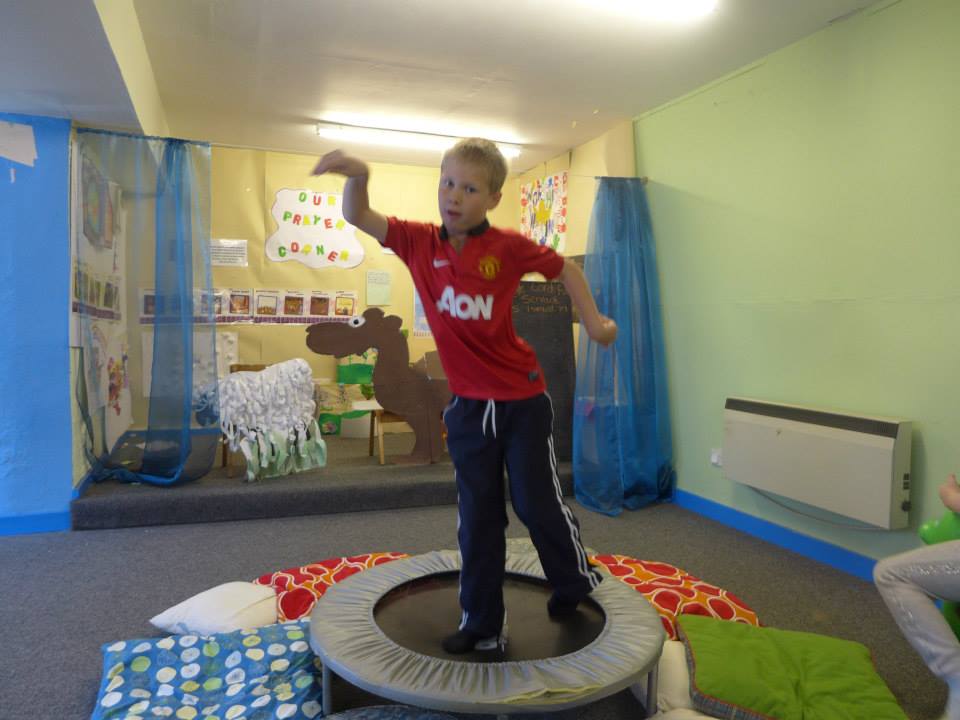
Splash - the children of Link Church - had great fun doing a sponsored bounce on Sunday morning to raise money for projects helping children in Brazil. Ruth Paton will take the money to Brazil with her when she goes out there in October.

So, for a whole hour, the children bounced, and bounced, and bounced!

 They bounced on a trampoline...


 They skipped...
 
 They bounced around the room on space hoppers...


Or just bounced on the spot....
 
They got better and better at staying on the pogo stick....
 
 They had bouncy races...
 
 
 Sometimes they just bounced right off the ground! (or is this a photo bomb?)
 
And they made some GREAT shapes!!


 Mercy joined in too, with a bit of help!

 
 And even when it was starting to get a bit tiring...
 
 They just kept on smiling - and bouncing!
 
Well done Splash! You were GREAT!